Bob Fornwalt
January 15, 1947 to September 22, 2025. By Harris Himes, as he wrote it. Published in Sponson Box, the journal of the USMC Vietnam Tankers Association, Vol. XVIII No. 2, 2026, pages 42–44; the printed pages follow the text.
On September 21, 2025, a justifiably monumental memorial service was held for Christian hero, Charlie Kirk. The day after, another American hero – a Marine – died inauspiciously in Lancaster, Pennsylvania. His name is Robert George Fornwalt. Both died before their time – one by assassination and the other by cancer. Our flag at Big Sky Christian Center in Hamilton, Montana flew at half-staff earlier for Kirk and then for Fornwalt.
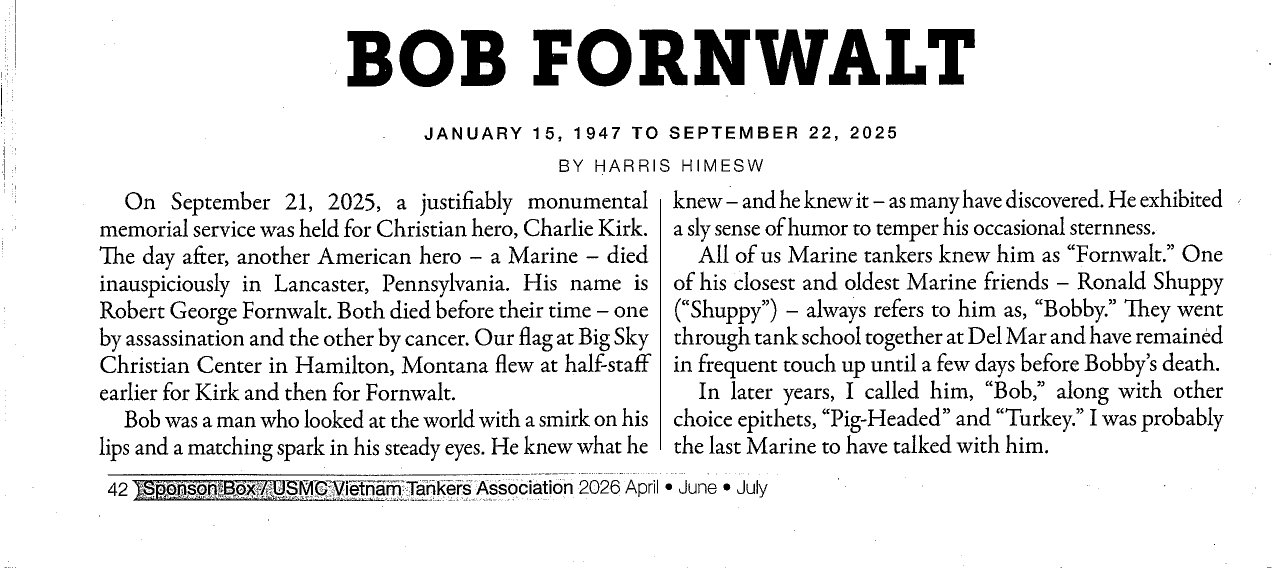
Bob was a man who looked at the world with a smirk on his lips and a matching spark in his steady eyes. He knew what he knew – and he knew it – as many have discovered. He exhibited a sly sense of humor to temper his occasional sternness.
All of us Marine tankers knew him as “Fornwalt.” One of his closest and oldest Marine friends – Ronald Shuppy (“Shuppy”) – always refers to him as, “Bobby.” They went through tank school together at Del Mar and have remained in frequent touch up until a few days before Bobby’s death.
In later years, I called him, “Bob,” along with other choice epithets, “Pig-Headed” and “Turkey.” I was probably the last Marine to have talked with him.
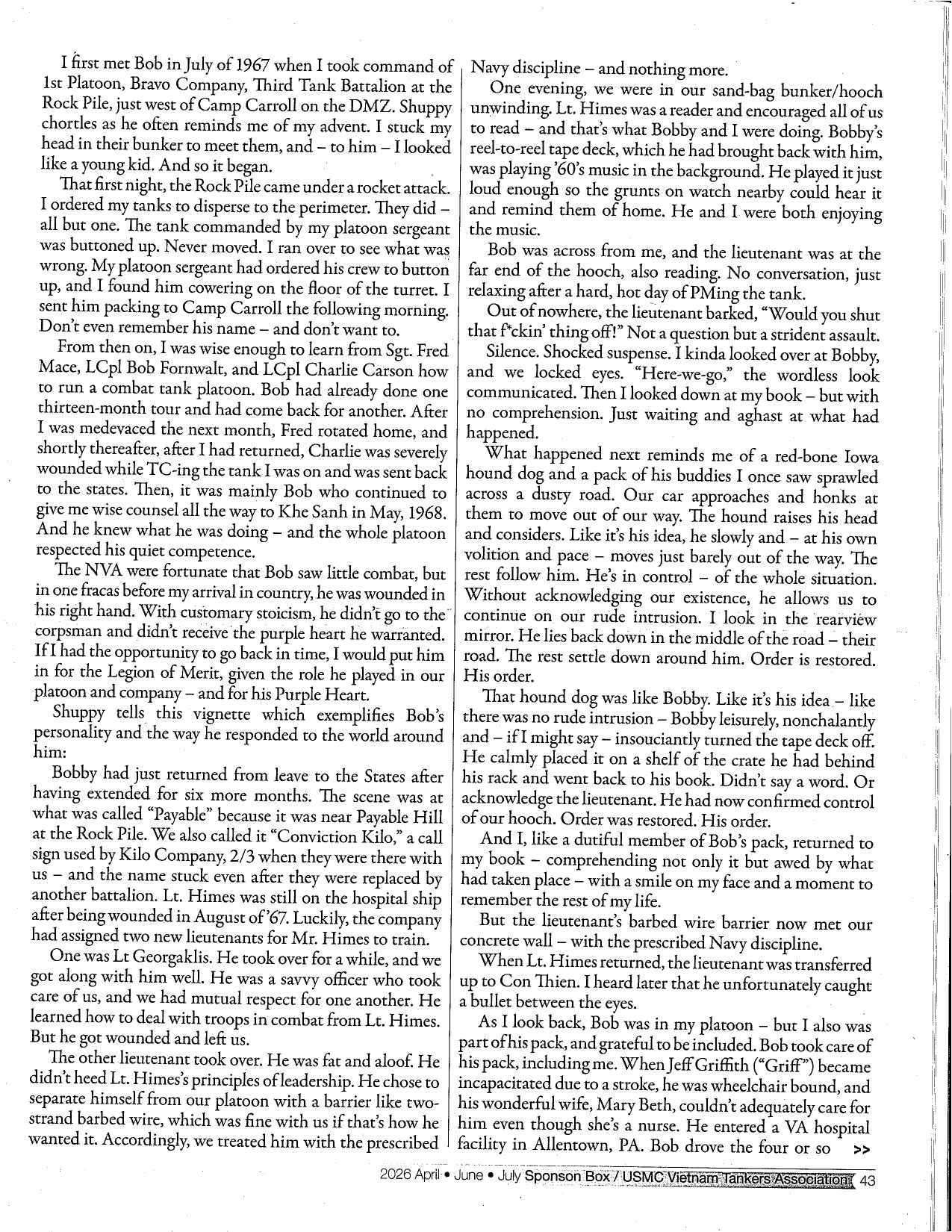
I first met Bob in July of 1967 when I took command of 1st Platoon, Bravo Company, Third Tank Battalion at the Rock Pile, just west of Camp Carroll on the DMZ. Shuppy chortles as he often reminds me of my advent. I stuck my head in their bunker to meet them, and – to him – I looked like a young kid. And so it began.
That first night, the Rock Pile came under a rocket attack. I ordered my tanks to disperse to the perimeter. They did – all but one. The tank commanded by my platoon sergeant was buttoned up. Never moved. I ran over to see what was wrong. My platoon sergeant had ordered his crew to button up, and I found him cowering on the floor of the turret. I sent him packing to Camp Carroll the following morning. Don’t even remember his name – and don’t want to.
From then on, I was wise enough to learn from Sgt. Fred Mace, L/Cpl Bob Fornwalt, and L/Cpl Charlie Carson how to run a combat tank platoon. Bob had already done one thirteen-month tour and had come back for another. After I was med-evac’d the next month, Fred rotated home, and shortly thereafter, after I had returned, Charlie was severely wounded while TC’ing the tank I was on and was sent back to the states. Then, it was mainly Bob who continued to give me wise counsel all the way to Khe Sanh in May, 1968. And he knew what he was doing – and the whole platoon respected his quiet competence.
The NVA were fortunate that Bob saw little combat, but in one fracas before my arrival in country, he was wounded in his right hand. With customary stoicism, he didn’t go to the corpsman and didn’t receive the purple heart he warranted. If I had the opportunity to go back in time, I would put him in for the Legion of Merit, given the role he played in our platoon and company – and for his purple heart.
Shuppy tells this vignette which exemplifies Bob’s personality and the way he responded to the world around him:
Bobby had just returned from leave to the States after having extended for six more months. The scene was at what was called “Payable” because it was near Payable Hill at the Rock Pile. We also called it “Conviction Kilo,” a call sign used by Kilo Company, 2/3 when they were there with us – and the name stuck even after they were replaced by another battalion. Lt. Himes was still on the hospital ship after being wounded in August of ’67. Luckily, the company had assigned two new lieutenants for Mr. Himes to train.
One was Lt Georgaklis. He took over for a while, and we got along with him well. He was a savvy officer who took care of us, and we had mutual respect for one another. He learned how to deal with troops in combat from Lt. Himes. But he got wounded and left us.
The other lieutenant took over. He was fat and aloof. He didn’t heed Lt. Himes’s principles of leadership. He chose to separate himself from our platoon with a barrier like two-strand barbed wire, which was fine with us if that’s how he wanted it. Accordingly, we treated him with the prescribed Navy discipline – and nothing more.
One evening, we were in our sand-bag bunker/hooch unwinding. Lt. Himes was a reader and encouraged all of us to read – and that’s what Bobby and I were doing. Bobby’s reel-to-reel tape deck, which he had brought back with him, was playing ’60’s music in the background. He played it just loud enough so the grunts on watch nearby could hear it and remind them of home. He and I were both enjoying the music.
Bob was across from me, and the lieutenant was at the far end of the hooch, also reading. No conversation, just relaxing after a hard, hot day of PM’ing the tank.
Out of nowhere, the lieutenant barked, “Would you shut that f\_\_\_\_in’ thing off!” Not a question but a strident assault.
Silence. Shocked suspense. I kinda looked over at Bobby, and we locked eyes. “Here-we-go,” the wordless look communicated. Then I looked down at my book – but with no comprehension. Just waiting and aghast at what had happened.
What happened next reminds me of a red-bone Iowa hound dog and a pack of his buddies I once saw sprawled across a dusty road. Our car approaches and honks at them to move out of our way. The hound raises his head and considers. Like it’s his idea, he slowly and – at his own volition and pace – moves just barely out of the way. The rest follow him. He’s in control – of the whole situation. Without acknowledging our existence, he allows us to continue on our rude intrusion. I look in the rearview mirror. He lies back down in the middle of the road – their road. The rest settle down around him. Order is restored. His order.
That hound dog was like Bobby. Like it’s his idea – like there was no rude intrusion – Bobby leisurely, nonchalantly and – if I might say – insouciantly turned the tape deck off. He calmly placed it on a shelf of the crate he had behind his rack and went back to his book. Didn’t say a word. Or acknowledge the lieutenant. He had now confirmed control of our hooch. Order was restored. His order.
And I, like a dutiful member of Bob’s pack, returned to my book – comprehending not only it but awed by what had taken place – with a smile on my face and a moment to remember the rest of my life.
But the lieutenant’s barbed wire barrier now met our concrete wall – with the prescribed Navy discipline.
When Lt. Himes returned, the lieutenant was transferred up to Con Thien. I heard later that he unfortunately caught a bullet between the eyes.
As I look back, Bob was in my platoon – but I also was part of his pack, and grateful to be included. Bob took care of his pack, including me. When Jeff Griffith (“Griff”) became incapacitated due to a stroke, he was wheelchair bound, and his wonderful wife, Mary Beth, couldn’t adequately care for him even though she’s a nurse. He entered a VA hospital facility in Allentown, PA. Bob drove the four or so hours from Lancaster to visit him. Once I was able to make it out there to see him, also. He was on the phone with Griff multiple times during the week. The same went for Shuppy. They were always yakking, and then I’d hear about it. He also kept in touch with Harry Christensen (“Super Jew”) in Marble Head, MA. We all exchanged phone calls frequently, and I’d make it out maybe once or twice a year to see them and others – usually with Mike Parker (a Marine-at-heart) who helps me run the shelter, and sometimes our Anatolian Shepherd-mix dog, Theo. Mike did most of the driving. We are all family.
Contrary to Marine protocol, I addressed my men by their first names, even though they always referred to me as, “Lieutenant,” or simply, “Sir.” Since we fought together and lived together, my men were family. And I didn’t call my older brother, Larry, the premier Marine of my state-side family, “Himes.” That would be absurd.
Our relationship in a combat environment was a symbiosis which won firefights and battles and kept us all alive and sane. However, I was routinely called on the carpet by a string of company commanders over my ten-and-a-half months in the field for my lapse because I wouldn’t play the hypocrite and resort to last names in the company area when we came in from the field. And my men appreciated that.
I understand that the military requires some system to select its officers. Generally – and certainly during Vietnam – the usual indicia was a college degree. Otherwise, you were enlisted. Of course, a college degree doesn’t automatically make a good officer. Shuppy had a degree but preferred to just do his time as a snuffy and get back to Iowa, but he was absolutely an integral part of our platoon. A college degree was my entry ticket, at least for consideration to become an officer. However, I learned early – and confirmed it over the years – many 17, 18, or 19 year-old enlisted men would have made fine officers – but for the lack of a degree. Many of my men would have made fine officers, and, incidentally, got degrees after they got out. Bob was such a man. He got a degree in mechanical engineering after active duty. But his leadership skills back then were obvious, and I put them to good use.
We all love and miss Bob mightily.
I miss his low, gravelly voice intoning: “Hello, Sir…,” or “Good afternoon, Mr. Himes…,” or, “One of these days I might make it to Montana. Susan wants to go.” Or he’d rumble, “Let’s get some ice cream,” or, “I’ll ask Susan,” or, “Shuppy says, ‘hello,’” or, “Say, ‘hi,’ to Parker.” Words I’ll never hear again – but remember.
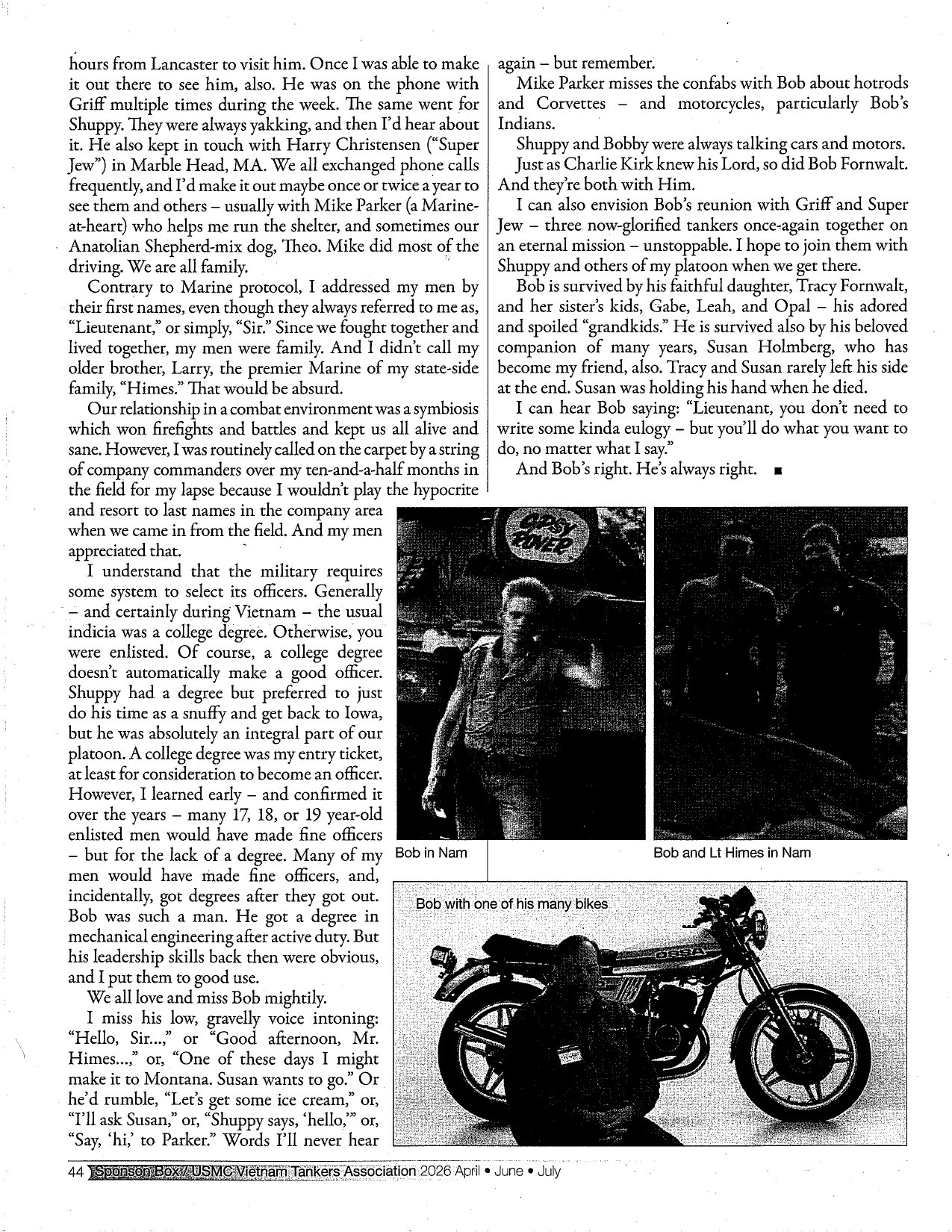
Mike Parker misses the confabs with Bob about hotrods and Corvettes – and motorcycles, particularly Bob’s Indians.
Shuppy and Bobby were always talking cars and motors.
Just as Charlie Kirk knew his Lord, so did Bob Fornwalt. And they’re both with Him.
I can also envision Bob’s reunion with Griff and Super Jew – three now-glorified tankers once-again together on an eternal mission – unstoppable. I hope to join them with Shuppy and others of my platoon when we get there.
Bob is survived by his faithful daughter, Tracy Fornwalt, and her sister’s kids, Gabe, Leah, and Opal – his adored and spoiled “grandkids.” He is survived also by his beloved companion of many years, Susan Holmberg, who has become my friend, also. Tracy and Susan rarely left his side at the end. Susan was holding his hand when he died.
I can hear Bob saying: “Lieutenant, you don’t need to write some kinda eulogy – but you’ll do what you want to do, no matter what I say.”
And Bob’s right. He’s always right.